
Project
Aiguasol in the BIOCAFA project: Driving a Circular Bioeconomy Model in Terra Alta
Aiguasol in the BIOCAFA project: Driving a Circular Bioeconomy Model in Terra Alta
ClientCatalan Bioenergy Cluster (CBC) & ACCIÓYear2026LocationTerra Alta (Catalonia)ServicesDistrict Heating & Cooling
The Terra Alta region faces several significant structural challenges, including population decline, the progressive ageing of its inhabitants, and a limited industrial base that constrains the generation of new economic opportunities. At the same time, the accumulation of agricultural and forestry residues, often without optimal management, creates environmental risks and additional costs for local producers.
It is within this context that BIOCAFA – Les Camposines Biopark has emerged, an initiative aimed at turning these challenges into drivers of development through a circular bioeconomy model. The project seeks to create a local production ecosystem capable of transforming underutilised agroforestry resources into renewable energy, bioproducts and organic fertilisers.
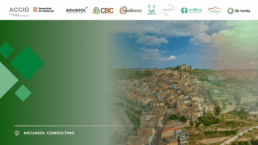
The initiative is being developed in La Fatarella and its surrounding area, within Catalonia’s Nuclear Transition Zones (ZTN), which are particularly affected by the planned closure of the Ascó and Vandellòs nuclear power plants.
With the support of ACCIÓ, the project is led by the Catalan Bioenergy Cluster (CBC), with technical support from Reset 2050, Uscala Blue, SD Verdia and Simbiosy, and the involvement of local cooperatives with a strong presence in the territory, including Agrícola Sant Isidre de la Fatarella and Energia del Bé Comú (EnBeCo). This alliance brings together technical expertise, industrial capacity and in-depth territorial knowledge to drive an initiative with a clear transformative ambition.
A collaborative model rooted in the territory
BIOCAFA is structured around a series of strategic actions that together form an integrated production and energy model:
- Local energy community
Development of hybrid energy services through the cooperative, covering both electricity and thermal energy, with the objective of meeting up to 70% of local energy demand through renewable sources. - Sustainable management of agroforestry biomass
Collection, treatment and valorisation of up to 30,000 tonnes of biomass per year, applying principles of proximity, sustainability and efficiency in territorial resource management. - Self-sufficient industrial biopark
Development of a production hub capable of generating renewable energy, bioproducts and natural fertilisers, while establishing business models that can be replicated in other territories.
Aiguasol’s contribution
Within the BIOCAFA project, Aiguasol contributes its expertise in local energy systems, including district heating networks, and in the development of business models linked to sustainable infrastructure.
Our work focuses on assessing the technical and economic feasibility of the existing district heating network and its potential future expansion at municipal scale, a key component for connecting energy production at the biopark with local heat demand. Specifically, Aiguasol is:
- Assessing the economic feasibility and sizing of the district heating network in order to develop a municipal energy service model.
- Analysing access and consumption costs for different user profiles and comparing them with alternative solutions for meeting heating demand, such as individual biomass boilers or aerothermal heat pumps.
- Establishing the foundations for a sustainable and scalable model with the potential to be replicated in other territories.
This approach ensures that the energy infrastructure is not only technically feasible, but also economically sustainable and accessible to the local community. At municipal scale, the two most favourable alternatives, with broadly similar results, are:
- Aerothermal heat pumps combined with collective self-consumption through an Energy Community.
- A large-scale district heating network, in line with the Master Plan and financed and managed by the local authority.
A rural development strategy
The project aims to deliver tangible impacts across the territory, including:
- Meeting up to 70% of local energy demand through renewable sources.
- Valorising up to 30,000 tonnes of agroforestry biomass annually.
- Developing replicable models for other Nuclear Transition Zones.
- Facilitating the transfer of knowledge and best practices to territories undergoing energy transition.
Beyond its immediate outcomes, the project represents a new approach to territorial development, based on the valorisation of local resources, clean energy production and cooperation between public and private stakeholders. Through initiatives such as BIOCAFA, Terra Alta is moving towards a more resilient, sustainable and locally rooted energy model, creating new economic opportunities while strengthening social cohesion.
👉 Discover more strategic projects in the Nuclear Transition Zone here: https://www.youtube.com/watch?v=_QCTHmF6LbY