
Project
Aiguasol drives energy excellence in the expansion of the Santa Oliva Library in Olesa de Montserrat
Aiguasol drives energy excellence in the expansion of the Santa Oliva Library in Olesa de Montserrat
ClientColl-Leclerc, Olesa de Montserrat City Council & the Barcelona Provincial CouncilYear2026LocationOlesa de Montserrat (Spain)ServicesSustainable building consultancy
A public facility connecting heritage, bioclimatic design, and climate action
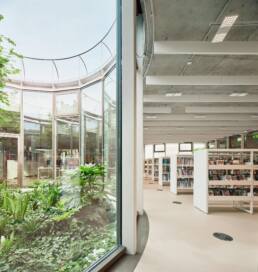
The transformation of public facilities presents an outstanding opportunity to redefine the relationship between architecture, energy efficiency, and the community. With this forward-looking vision, Aiguasol has spearheaded the energy optimization and certification strategy for the expansion of the Santa Oliva Library in Olesa de Montserrat—an ambitious project designed by the architecture firm Coll-Leclerc and jointly promoted by the Olesa de Montserrat City Council and the Barcelona Provincial Council.
The existing building, originally built in 1994 and expanded in 2004, has a total area of 2,077 m² (1,120 m² of new construction + 957 m² of renovation) and 1,133 m² (green roof). The new expansion has been conceived as a qualitative leap to transform the infrastructure into a high-performance building, poised to become a local benchmark for sustainability and citizen well-being.
Advanced simulation to maximize comfort and efficiency
The Aiguasol team has developed a comprehensive study of the building’s envelope, applying cutting-edge energy, lighting, and environmental comfort simulation tools. This exhaustive analysis focused on the following key strategies:
- Passive cooling and natural ventilation: A rigorous study of the openings has allowed us to design a highly effective cross-ventilation strategy. The selected configuration guarantees more than 4 air changes per hour, enabling optimal nocturnal thermal dissipation capable of reducing the indoor temperature from 27 °C to 24 °C during the summer months. As a complement, we prescribed the opening of windows alongside the incorporation of opaque shutters with improved transmittance to maximize thermal control of the space.
- Solar protections adapted to the Mediterranean climate: We evaluated multiple vertical louver configurations on the northwest and southwest facades (analyzing their orientation, spacing, and length) to guarantee precise solar control. In parallel, the thermodynamic impact of the existing vine pergola (wisteria) was validated, proving that the vegetation’s density drastically reduces cooling demand and integrates nature as a climate tool.
- Optimizing natural light and visual comfort: Through international metrics such as spatial Daylight Autonomy (sDA) and Annual Sunlight Exposure (ASE), we designed interior spaces that achieve excellent lighting quality, maintaining an sDA above 60%. To mitigate any risk of glare from the interior courtyards and skylights, the installation of diffuser screens and blinds was recommended, thus ensuring an optimal environment for reading and working. Finally, the skylights installed on site consist of double-glazed ESG (‘Energy Saving Glass’) units with a Ug-value of 1.1 W/m²K, a visible light transmittance of 77%, and allowing only 58% of solar energy to pass through.
Towards energy excellence
Our intervention served to rigorously define all the thermal parameters of the envelope (facades, roof, flooring, and glazing). Using dynamic simulations, we certified that the final design more than meets the stringent requirements of the Technical Building Code (DB-HE1 and DB-HE0).
Thanks to the comprehensive optimization of the passive design, we have successfully reduced the heating demand to below 15 kWh/m² per year, bringing the building in line with the most rigorous and demanding criteria of international standards for high energy efficiency and nearly zero-energy consumption.
This result makes the Santa Oliva Library a clear example of how public architecture can evolve towards decarbonized and resilient models in the face of the climate emergency. This project demonstrates that sustainability goes far beyond simply reducing energy consumption; it is a firm commitment to transforming public facilities into genuine spaces of health, social cohesion, and an organic connection with the natural environment.
Image source: Coll-Leclerc (2026)