
The building sector continues to be a key element in European climate policy, as it consumes nearly 40% of energy and is responsible for over one-third of CO₂ emissions. Given its substantial impact, minor adjustments are insufficient; a fundamental shift is required in how buildings are constructed, renovated, and inhabited. The draft of the new Technical Building Code 2026 broadens the concept of sustainability and aligns it with the objectives of the EPBD.
Over the past two decades, the European Union has progressively developed an increasingly stringent regulatory framework, from the 2002 EPBD to the 2024 Directive. Yet the primary focus has remained largely unchanged: reducing energy consumption during building operation. The 2019 Technical Building Code already required all new constructions to meet nZEB standards, improving operational efficiency but overlooking a significant aspect: the environmental impact of construction itself.
Contributions of CTE 2026 compared to previous regulations
This is where the 2026 Technical Building Code (CTE) makes a critical contribution. For the first time, sustainability is no longer defined solely by energy savings, but by minimizing the overall environmental impact throughout a building’s life cycle. Materials, manufacturing, transportation, and demolition will no longer be secondary considerations when designing new buildings.
The creation of the Environmental Sustainability Basic Document (DB-HSA) is perhaps the most significant innovation in this reform. In particular, HSA1 introduces the Global Warming Potential (GWP) indicator. This metric requires quantifying all emissions associated with a building, from raw material extraction to the end of its life cycle. This represents both a regulatory and cultural shift: energy efficiency alone is no longer sufficient. A building cannot be considered sustainable simply because it consumes little energy if its construction entails high embodied carbon.
It should be noted that initially, calculating the GWP will be required, but until 2030 there will be no mandatory limit for this indicator. This provides the sector with several years to consolidate methodologies and correctly implement the regulation.
The second major innovation, HSA2 on sustainable mobility, also responds to an EPBD request promoting electromobility. From now on, electric vehicle charging points and bicycle facilities are no longer optional but part of the basic requirements for any new building. This is an intelligent approach to addressing indirect emissions associated with buildings, which are often as significant as operational emissions.
CTE 2026 therefore represents a clear step toward a broader vision of sustainability, in which carbon emissions accounting extends beyond energy consumption. At the same time, it reflects a cautious approach to avoid overburdening the sector with an abrupt transition.
How Aiguasol approaches building design
At Aiguasol, we have long used Life Cycle Assessment (LCA) as a strategic design tool rather than a final compliance formality. Integrating environmental impact into design decisions has allowed us to optimize construction solutions from the earliest project stages, demonstrating that buildings with a reduced carbon footprint are feasible.
In this context, the new CTE essentially generalizes practices already implemented in advanced projects, often driven by sustainability-minded developers or certification requirements such as LEED, VERDE, or BREEAM. The difference now is that these studies are no longer voluntary—they form part of a common framework for the entire sector.
From our perspective, CTE 2026 is heading in the right direction, moving beyond a narrow view of sustainability and incorporating both the global environmental impact of buildings and their relationship with mobility. This is not merely a regulatory adjustment, but a conceptual shift linking building practices to real climate objectives.
Nevertheless, the period until 2030, during which only LCA or GWP calculations will be required without binding limits, reflects a prudent transitional strategy. It allows the sector to consolidate methods, tools, and technical capabilities, while still enabling construction without restrictions on embodied emissions. The question is not whether the new CTE is better than the previous one, but whether it arrives with the speed and ambition the challenge demands.
Setting limits for new buildings is necessary, but likely insufficient; the real challenge remains the aging building stock. The key question goes beyond which limits will be imposed: who will finance the massive transformation this will require, and how? As a society, are we prepared to assume this cost and responsibility?
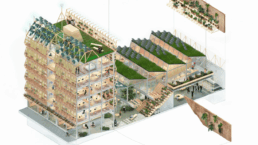
Application of LCA in Infinito Delicias, a strategic project by Husos and Elii + Ultrazul + Daniel and Nina Carasso Foundation. HOLCIM 2023 Award Winner.