

Project
Renewable energy generation in public spaces: Aiguasol’s services for new urban developments
Renewable energy generation in public spaces: Aiguasol’s services for new urban developments
Year2025LocationBarcelona, SpainServicesTechnical evaluation of photovoltaic energy generation performance in the urban public domain
Barcelona is advancing toward a more sustainable and energy-efficient urban model. A key step in this direction is the Municipal Instruction on Renewable Generation, which requires that any new urban development—such as city blocks, promenades, or public squares—integrate strategies to maximize photovoltaic energy generation in public spaces. The objective: to leverage available solar resources and reduce dependence on fossil fuels while seamlessly integrating technology into urban design.
Harnessing solar energy without compromising design
At Aiguasol, we provide specialized services tailored for architects who want to ensure their projects comply with this regulation without compromising urban quality or public space design. Our services include:
- Analysis of solar resources and photovoltaic potential within the project area.
- Sunlight and shading studies, considering buildings, overhangs, and vegetation.
- Feasibility assessment of photovoltaic solutions, such as pergolas integrated into squares and interior courtyards.
- Comparative scenario analysis to identify the optimal balance between energy generation, functionality, and landscape integration.
- Preliminary design of the photovoltaic installation, including specification of equipment and associated integration costs.
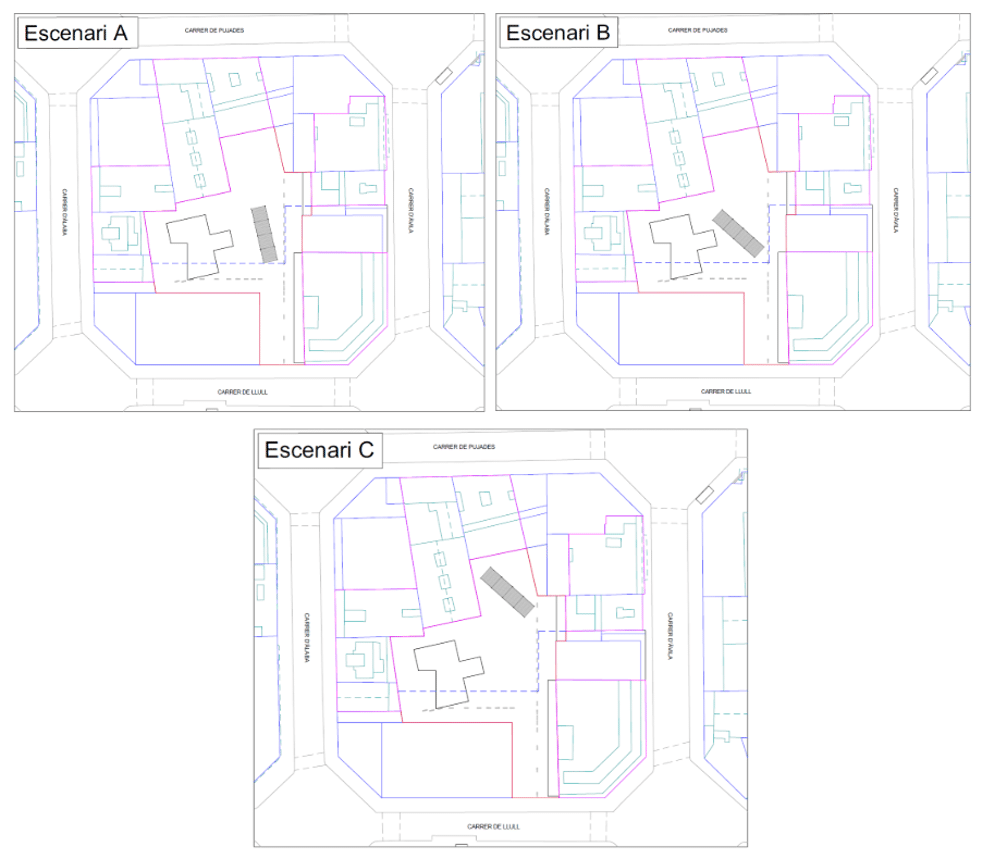
A prominent example is the Subsector 6 Urbanization Project of PERI Llull Pujades Ponent (22@), where we analyzed solar resources within the block and determined the optimal location for a photovoltaic pergola based on three strategic scenarios, selecting the solution that best balanced energy performance and urban integration in consultation with our clients.
Aiguasol methodology: technical and urban rigor
Our approach combines advanced simulations, 3D modeling, and local climate data to ensure precise, actionable results. In the Subsector 6 project, the challenge was not only to demonstrate sufficient solar resource but also to determine where and how to integrate a photovoltaic pergola without compromising the urban quality of the block’s interior. The methodology was structured in four key phases:
1. Detailed understanding of the urban context
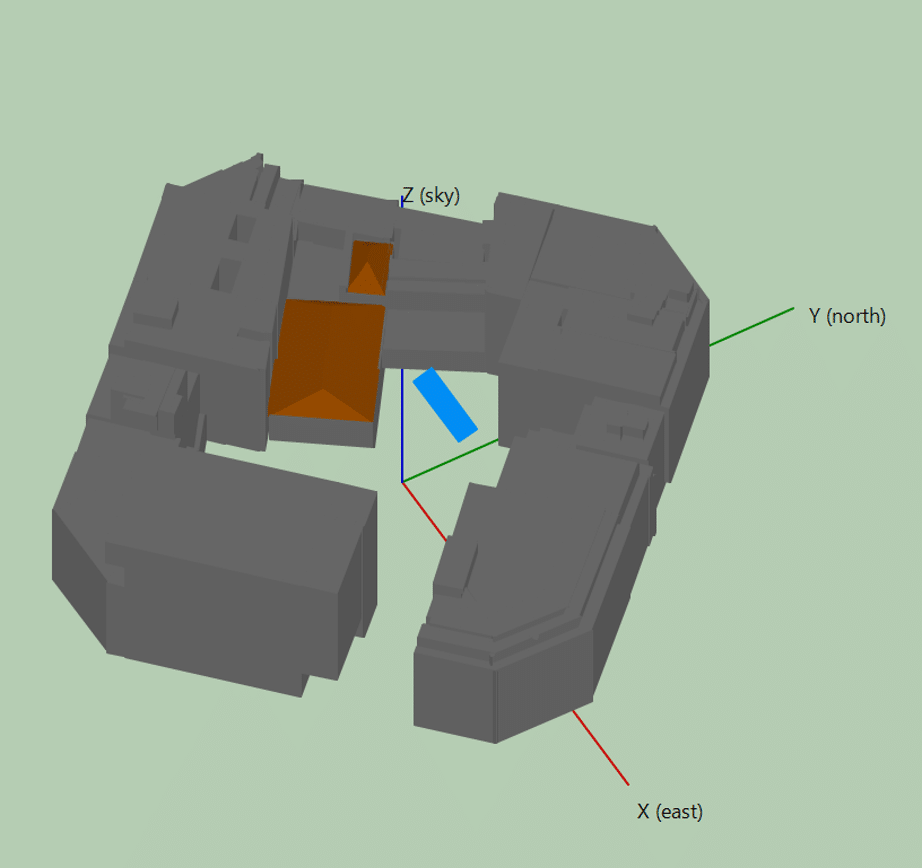
A simplified 3D model of the area was developed, incorporating:
- The volumes of surrounding buildings.
- Levels of open interior spaces.
- Shading elements (cornices, overhangs, etc.).
- Planned tree growth according to the urbanization proposal.
This model allowed for rigorous analysis of shadows throughout the year and a precise understanding of how volumetric configurations affect photovoltaic potential.
2. Hourly solar irradiance analysis
Using the 3D model and local climate data for Barcelona (typical meteorological year), an hourly analysis of irradiance was performed on a grid of points at 3.5 m height—the projected pergola level.
For energy simulation, System Advisor Model (SAM), a reference tool for grid-connected photovoltaic system evaluation, was used to integrate urban geometry, climatic conditions, and real equipment parameters.
This work produced an annual sun exposure map, identifying:
- Areas with permanent or frequent shading.
- Zones with high incidence of usable solar hours.
- A central corridor offering a balance between solar exposure and urban functionality.
The analysis validated photovoltaic feasibility and provided an objective tool for comparing alternative configurations.
3. Scenario definition and comparison
Three installation scenarios were analyzed:
- Scenario A – Urban-Optimal: Placement aligned with circulation, leisure areas, and landscape integration.
- Scenario B – Orientation-Optimized: Tilt and orientation adjusted while maintaining the footprint position.
- Scenario C – Maximum Generation: Moved toward the area with the highest solar resource identified on the sun exposure map.
The comparative study quantified annual energy production, shading losses, and overall system efficiency for each option. Notably, the difference in production between the urban-optimal scenario (A) and the maximum-generation scenario (C) was small, whereas the impact on urban quality and functionality was significant.
4. Decision based on energy–urban balance
The analysis demonstrated that:
- Scenario A provided sufficient solar resource to justify installation.
- The potential energy gains of Scenario C did not compensate for the loss of urban coherence.
- The theoretically optimal orientation (south) does not always yield the best outcome in complex urban environments, where shadows significantly influence real performance.
This methodology enabled objective project decision-making, ensuring compliance with the Municipal Instruction on Renewable Generation and achieving an optimal balance between energy production, climatic comfort, and public space quality.
Sustainable and energy-conscious urban planning
Our service ensures that urbanization projects meet municipal regulations while transforming public spaces into true energy assets. In doing so, we contribute to a more sustainable, efficient, and resilient Barcelona, where urban planning itself becomes part of the solution to future climate and energy challenges.
.